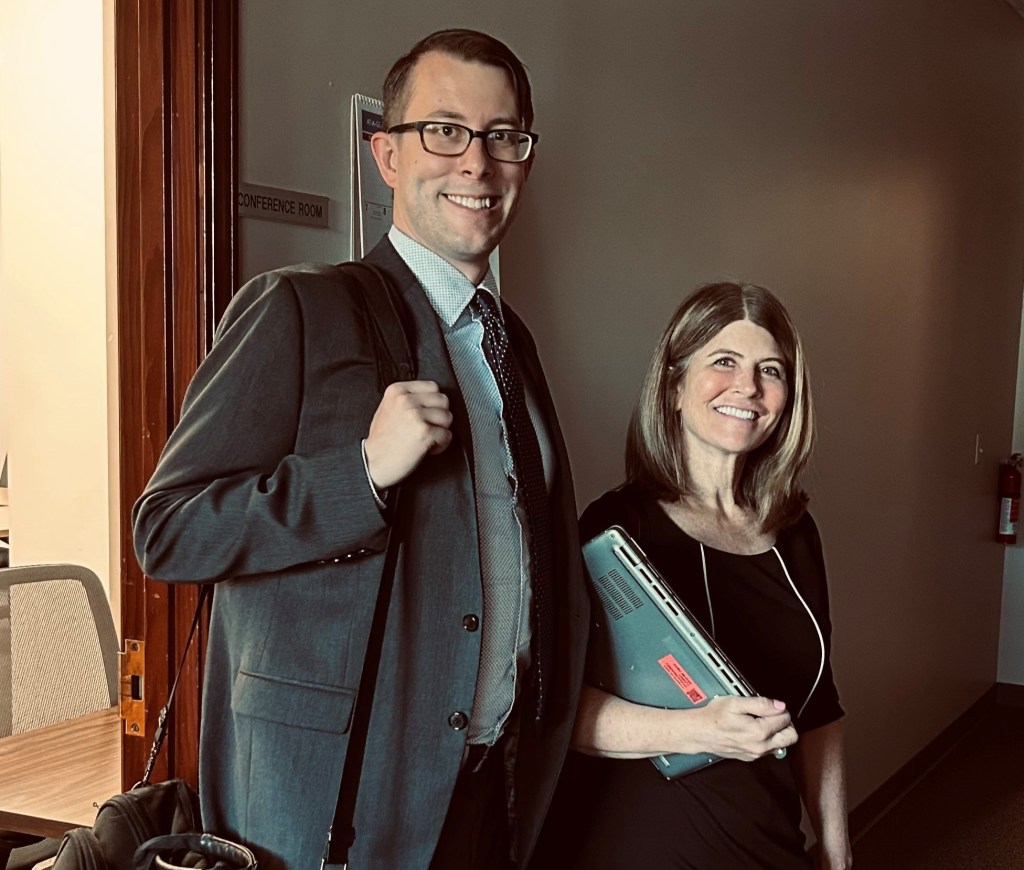
Welcome to the King County Department of Public Defense’s Profiles in Service, a series that will highlight the contributions of our committed public servants and provide a platform for attorneys and professional staff to share their insights on the evolving practice of public defense. For our inaugural interview, recently retired attorney supervisor Deb Wilson sat down to reflect on her nearly 40 years as a public defender.
Deb began her career as an investigator at The Defender Association (TDA), nearly 30 years before the four nonprofits that had historically provided public defense in King County were combined to become DPD. She then went to law school at the University of Washington, returning to public defense as an attorney at the Associated Counsel for the Accused for the remainder of her career.
Deb represented clients charged with misdemeanors and felonies, including winning a not guilty verdict at trial for a client charged with murder. She concluded her career at DPD as a supervisor in felony practice, where King County’s next generation of public defenders benefitted from her experience and mentorship.
The following Q&A has been edited for length and clarity.
What drew you into public defense?
I got my first job in public defense while I was still in undergrad, from an ad pinned to a bulletin board on campus advertising an internship with TDA. I thought it would be a great opportunity to get some exposure to the work and I quickly realized I couldn’t get enough. I spent 12 or 13 years as an investigator where I got to work on every kind of case, including murder trials and many other serious felonies. Eventually, I was inspired by a fellow investigator who decided to go to law school and I followed suit.
Even though I tried a few other areas of practice while I was in law school, nothing made me feel alive the way I felt when working in public defense. The work made me feel useful and purposeful, because I wasn’t just getting a chance to help people who needed someone in their corner – I treasured the intellectual challenge of making sure the government wasn’t cheating even in cases where I knew the facts or the law weren’t on our side. I had a few friends who offered to help me get a job at a big firm or something when I was graduating law school, but I knew I would have felt dead inside at a job like that. That was just not me at all.
How has the practice of public defense changed since you took on your first case?
So much technological change has happened since I was assigned my first case as an investigator in the 1980’s, but even beyond the prevalence of DNA evidence and cell phones, there are so many crimes now that nobody even could have conceived of back when I first started. It used to be that things were very much witness-focused; physical evidence was mostly limited to fingerprints, and maybe you’d go out to a scene and measure the distance of where some part of the alleged incident was supposed to have occurred. Now, everybody has a camera/recording device with them all the time. That has very much changed the entire practice of public defense.
I remember a murder case from when I was an investigator where the client was charged with killing the man who killed his brother in a drug deal gone bad. The client told us he was in Montana at the time of the murder, having gone there with his girlfriend and other relatives shortly after his brother’s funeral. While in Montana, he used an alias, for which he had a driver’s license and used that to obtain a fishing license. I interviewed and obtained notarized statements from those who had contact with him in Montana and gathered phone bills which documented collect calls he made (land line to landline) while he was there. His family had purchased a pre-paid bus ticket and wired it to him (under his alias name) for him to sign for and pick up in Montana. I was able to track down the hard copy of the ticket order which had the ticket number issued, and the receipt showing he had signed when he picked it up on the day of the murder. I was then able to contact Greyhound had them go through their torn tickets to confirm the ticket had been torn in each major hub along the way, showing that he had actually boarded and been on the bus at the time the murder took place. We were able to bring all of this alibi evidence to the State and they dismissed.
How did you manage the stressful nature of working in public defense?
There certainly are periods I look back on and I think, “how the hell did I do that?” There was a time when I was in back-to-back murder trials that each took two months. The first one in particular was super stressful, not just because it was a murder trial, but because we 100% believed our client was innocent. The burden you carry when you’re going to trial with somebody you believe is innocent is just unbelievable. Every client deserves a fair trial, and you’re always stressed making sure that the government isn’t violating their rights, that the witnesses don’t veer too far off what is expected, that you don’t ask the wrong question, or forget The Big Thing, but there’s a different level of pressure when it’s on you to convince a jury that the prosecutors genuinely got the wrong guy.
I always tried to tell my colleagues, and then the people in my unit when I became a supervisor, that you must carve time out for yourself. Sure, when you’re in trial and you need to hash out which jurors you want and you need to stay at the office until 10pm, that’s what the job requires of you. But absent that, it was important to me to leave the office, go get some exercise, have a quick dinner with my husband, and then work until midnight if necessary. I knew that I would be a lot less resentful and have at least some slivers of a life if I did that.
What kept you engaged in this work?
Without a doubt, the camaraderie of the people I worked alongside. No one understands what you go through better than the people who are also in the trenches. In both murder trials where we were able to get a favorable verdict for the client, the teamwork aspect was absolutely key to our success.
I loved working with my co-counsel on each case, Matt Sanders and Kell Brauer, but the investigation work on both cases was second to none. Tom Riley and Morgan True brought creativity, deep knowledge of the case, and a willingness to do whatever, whenever we needed it and truly worked side by side with us to develop the defense theories in those cases. I also had fantastic paralegal support from Gary Shaleen and Cesar Garcia who would drop whatever they were doing to jump in and help, even if all we needed was someone to keep us calm and problem solve when something unexpected happened at trial.
I could never have done this job without all the people along the way that I snickered with, celebrated with, cried with, and yelled and screamed with about the frustrating aspects of the work. There’s so much of that camaraderie that you’re not going to get as a solo practitioner or in a big firm where you’re competing against your colleagues. I’ve never really worked anywhere else, but I get the feeling it’s not like that in other law offices.
When you reflect on your time at DPD, is there a case where you felt you made a difference or client whose story has stuck with you over the years?
A client in one of the murder trials where we got a not-guilty verdict will always stick with me. During the course of the trial, we became very close with the client and his family. I still stay in touch with his mom, and I think Matt is still connected with other family members too.
This client spent more than a year and a half in jail before we could get the case to trial after taking it over from a private attorney. It’s one thing to do that much time for something you didn’t do, but what really struck me about his situation was that he didn’t know if he would ever get out despite knowing he was innocent. To just sit there for all that time and wonder if that is what your life is going to be from now on and the stress that it put on his family, that had a profound effect on me. He did get released and even got some compensation from a civil suit against the government, which is not typical for most clients who get a not-guilty verdict.
But he couldn’t get that year and a half back, which was made even worse when I learned the devastating news that he died in an accident at work three years after he won his trial.


