Cecilia Atkins, a rising 3L student at Michigan Law, chose to spend her summer internship at DPD largely because of Washington’s unique Rule 9 licensure that allows supervised students to speak on the record. At the start of the 10-week program, she took over a handful of cases from a public defender who rotated into felonies from practicing in Seattle Municipal Court.
Although Cecilia had heard from classmates at Michigan who had interned at DPD that she’d have the support from supervisors and non-attorney staff to provide the high-quality representation her clients deserved, taking on more clients than she’d ever represented in a clinic seemed daunting at first. Then, she started meeting the people whose interests she spent the summer working to serve.
“I had so many concerns about telling [my clients] that I’m an intern, but they have been incredibly trusting. I’ve been lucky to work with so many clients who are incredibly kind people.”
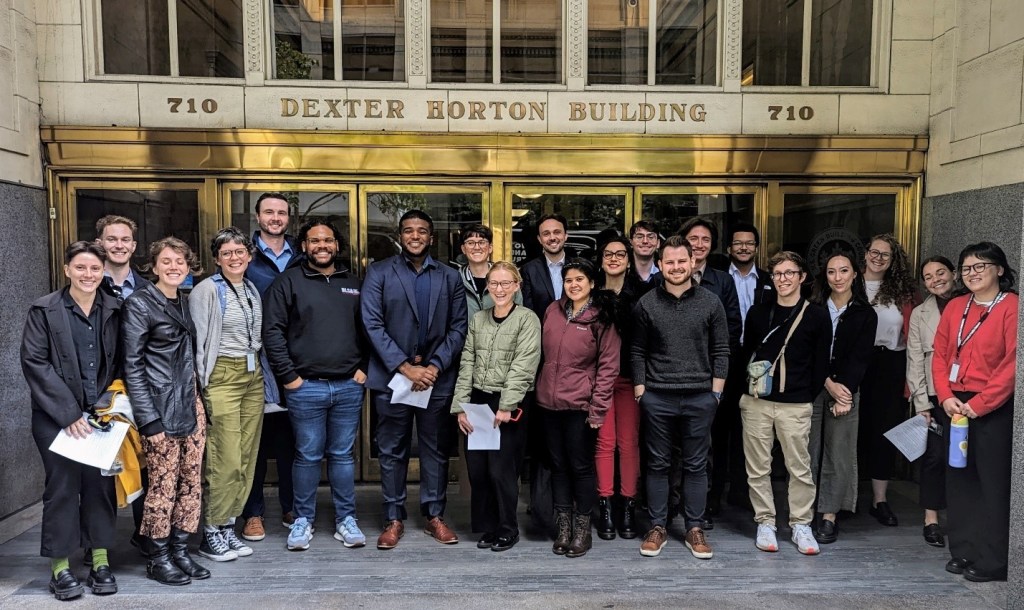
Many of DPD’s 21 summer interns reflected similarly enthusiastic stories of having the opportunity to provide high-quality, client-centered advocacy. They sought release for clients at arraignment, wrote motions seeking to suppress unconstitutionally seized evidence, cross examined police officers, and prepared entire trials. Through it all, they stressed the importance of the support they received from supervisors and line attorneys at every step – not only in giving them the confidence to advocate on the record, but in fostering the camaraderie among interns that helped make the experience so rewarding.
“I couldn’t stop smiling,” said Bradley Marshall, a rising 3L at Seattle University School of Law, thinking back on winning release for a client charged with Assault IV in Seattle Municipal Court. After prevailing on his argument that the scant three-sentence narrative in the police report could not establish probable cause to support the charge against him, he recalled seeing his supervisor and his fellow interns reflecting his beaming grin back at him from the gallery.
Elise Brown, a rising 3L at NYU, also found the collaborative environment at DPD essential in learning the practical skills she hoped to build during her internship – especially in cross examination.
“Cross is much less intuitive than opening or closing; it’s a unique skillset,” Elise said. “It’s really hard to learn things like impeachment without actually doing them.”
Elise reviewed her draft set of questions for every cross examination with her co-counsel, who made time to provide feedback on which lines of attack to prioritize and how to overcome anticipated objections from the prosecution. Then they’d repeat the process after each cross examination with a focus on where she could have let a point go, which Elise said gave her confidence she was improving on an extremely difficult skill.
That dedication to making time for providing feedback on work product also extended to motions and briefs DPD’s interns authored in both felony and misdemeanor cases.
For Tyler Zirker, a rising 3L at Georgetown, writing a motion to suppress evidence obtained from a pretextual stop in a DUI case earned him his “first big win as a public defender” – after the attorney who assigned him the project filed Tyler’s motion, the prosecution dismissed all charges against the client. Following the victory, Tyler said he appreciated how both the attorney of record and his supervisor offered to meet with him to further polish the motion so he could use it as a writing sample in applying for a job in public defense when he returns to campus this fall.
“I want to go somewhere where I can actually help people”
This summer’s class of interns joined DPD just as the department began implementing the WSBA’s newly adopted caseload standards for public defenders. For a generation of law students concerned with the sustainability of a career in public defense, the welcome news of reduced caseloads and consequentially more time to advocate for each client sparked cautious optimism.
“When I talk to public defenders, people love the work but they all talk about burnout,” Tyler said. “The emotional load is very heavy, the caseloads are very heavy, and it’s hard to make it a 9-5. I want to have time for my clients. I want to go somewhere where I can actually help people, and a place that promotes having work-life balance fits that.”
As someone who plans to take advantage of the federal government’s public service loan forgiveness program, Tyler emphasized the importance of finding an office that supports its public defenders in dealing with the burnout inherent in the field. When attorneys have the kind of support that he’s seen during his internship, Tyler said, it empowers them to provide the kind of representation that keeps prosecutors on their toes and hold law enforcement accountable when they violate a client’s constitutional rights.
Nora Gunning, rising 3L at Seattle University College of Law, also took note of the way many public defenders she worked with intentionally set boundaries to manage the unavoidable stress of shouldering responsibility for the freedom of their clients. She drew encouragement from the fact that both of her supervisors are parents, demonstrating that a family life could be possible while serving her values.
At the same time, Nora said that she found it hard to plan on the sustainability of a career as a public defender until she sees local and state policymakers provide the funding needed to fully implement the WSBA’s caseload standards over the next three years. “If the rule ends up being the reality, that’s incredible and provides an opportunity to have a job for decades, which I think is rare in public defense.”
As her internship came to a close, Nora said she feels “wary, but heartened” about the long-term viability of pursuing a career as a public defender after seeing the quality of advocacy made possible by the sustainable caseloads DPD attorneys carry in Seattle Municipal Court.


 For The Defense